Sequential Preparation
You may wish to review Common Fingers and Guide Fingers before continuing with this lesson.
Sequential Preparation allows for easier and more exact harmony (chord) changes while arpeggiating. When strumming, all fingers required by the new chord must come down simultaneously, but arpeggiation gives us the opportunity to distribute the labor over time.
Sequential preparation involves not only bringing the left hand fingers to the fretboard in the order in which they are required, but also at the exact moment. By taking the time to study and plot the
sequential preparation, you end up with smoother transitions and precise agreement between the hands.
Example 1
Sequential Preparation allows for easier and more exact harmony (chord) changes while arpeggiating. When strumming, all fingers required by the new chord must come down simultaneously, but arpeggiation gives us the opportunity to distribute the labor over time.
Sequential preparation involves not only bringing the left hand fingers to the fretboard in the order in which they are required, but also at the exact moment. By taking the time to study and plot the
sequential preparation, you end up with smoother transitions and precise agreement between the hands.
Example 1
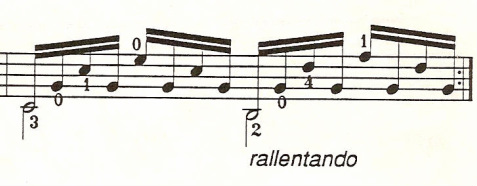
Here, the harmony change is taking place on the third beat. At that moment, the previous chord's fingers will clear
and the second finger will depress the bass note B. Two notes later, the fourth finger will come down on the D and finally, two notes after that, the first finger will depress the F.
Example 2
and the second finger will depress the bass note B. Two notes later, the fourth finger will come down on the D and finally, two notes after that, the first finger will depress the F.
Example 2
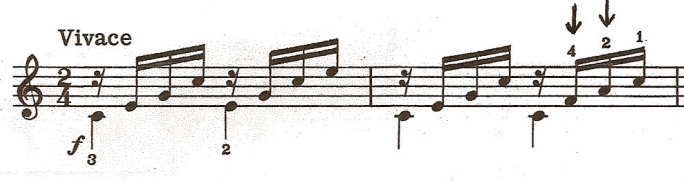
In this example, the first and third fingers are already in place from the previous measure. First we will observe Common Fingers , and then sequentially prepare the fourth and second fingers at the arrows.
Now is a good opportunity to discuss the hierarchy of left hand fingerings:
1. First, use Common Fingers if they are available, if not
2. Look for Guide Fingers , if there are none
3. Use Sequential Preparation
Now is a good opportunity to discuss the hierarchy of left hand fingerings:
1. First, use Common Fingers if they are available, if not
2. Look for Guide Fingers , if there are none
3. Use Sequential Preparation
Copyright © 2011 by Thomas Coffey All Rights Reserved Internatonal Copyright Secured