• Home
  • Adult Lessons
  • Lessons for Children
  • Testimonials
  • Sheet Music / TABs
    • A Major Pull-Off
    • A Minor Pull-Off
    • Adagio in E Minor
    • Afternoon Descending
    • Allegretto in C - Opus 44, No. 2
    • Allegretto in E Minor
    • Allegretto in C
    • Allegro in A Minor
    • Allegretto in G
    • Allegro Spiritoso Opus 1, No. 10
    • Andante in A Minor
    • Andante in E
    • Andantino in C
    • Andantino Grazioso
    • Aurora
    • Blackbird
    • Bolero
    • Bulerias
    • Bushi
    • Canon
    • China Star
    • Copla
    • Country Dance, Opus 127 No. 1
    • Country Dance, Opus 127 No. 4
    • Country Dance, Opus 127 No. 5
    • Country Dance, Opus 127 No. 12
    • Divertimento - Opus 40, No. 6
    • Dos Pedasos
    • Double Hammer Waltz
    • Elephant, Elephant
    • Estudio in A Minor
    • Estudio sin Nombre
    • Estudio sin Nombre (Intro)
    • Estudio Techno
    • Falling Snow
    • The Flight of Icarus
    • Lamento Gitano
    • La Folia (variation)
    • Forty-Two Degrees
    • The Hunt
    • Inclinado en la Tarde
    • Fourth & Five
    • Inquieto
    • Leccion 58
    • Leccion 61
    • Leccion 62
    • Low E Legatos
    • Lower Neighbor
    • Lullaby
    • La Lunita
    • Major Slurring
    • Malaguena
    • Michelle
    • Minor Slurring
    • Minuet in G
    • Minute Study
    • Moderato in G
    • Moon in Pecan Tree
    • Moorish Danse
    • Ninito
    • Ninth Waltz
    • Nocturne
    • One Step Forward
    • Pagoda Sunrise
    • Pamplona
    • Pedasos
    • Pequeno
    • Pequeno Tarantela
    • Por la Tarde
    • Promenade
    • Rainsong
    • Romance
    • Romance in E Minor
    • Sonatina in Am
    • Song of the Desert
    • El Sueno Ultimo
    • Third Waltz
    • Three of a Kind
    • Valse in G
    • Waiting for Mu Shoo
    • Waltz in C
    • Waltz in E
    • Waltz in Em
    • Water Downriver
    • Water & Light
    • Yesterday
  • Techniques & Tips
    • Anticipatory Replacement Fingers
    • "Artificial" Harmonics
    • Ascending Slurs (Hammer-Ons)
    • Bar Chord Basics
    • Bar Chord Forms>
      • Bar Chord Forms (Major & Minor)
      • Bar Chord Forms (Dominant 7)
      • Bar Chord Forms (Major 7)
      • Bar Chord Forms (Minor 7)
    • Better Bar Chords
    • Better Chord Transitions
    • Better Harmonics
    • Block Chord Accompaniment Patterns
    • Block Chords
    • Building Dominant 7 Chords
    • Building Major & Minor Chords
    • Building Open Chords on the Fretboard
    • Common Fingers
    • Descending Slurs (Pull-Offs)
    • The Free Stroke with "P"
    • Guide Fingers
    • Guitar Anatomy
    • Harmonics
    • Holding the Guitar
    • How to Change Strings
    • Introduction to Arpeggios
    • Introduction to the Left Hand
    • Introduction to the Right Hand
    • Introduction to Strumming
    • Introduction to Tuning
    • Left Hand Position
    • Open Chords>
      • Open Chords (Major & Minor)
      • Open Chords (Major 7)
      • Open Chords (Dominant 7)
      • Open Chords (Minor 7)
    • Pedal Point with "P" & "I"
    • Relative Positioning
    • Replacement Fingers
    • Rest Stroke Alternation
    • Sequential Preparation
    • Shifting
    • String Assignment
    • String Crossing
    • String Names
    • Strumming Patterns
    • Tuning With Harmonics
    • Unison Tuning
  • Contact
TampaGuitarLessons.com

Relative Positioning

You may wish to review Shifting before continuing with this lesson.

Relative Positioning involves preparing the fingers of the left hand, ahead of time, over the strings they will play after the shift.  Ideally, the only thing you want to do once you get to the new Position is to drop the fingers on the strings over which they have prepared.  This makes shifting simpler and more accurate.

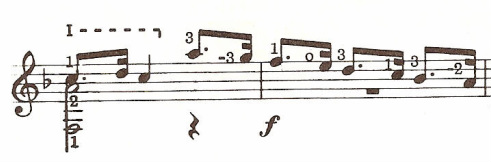
In the first example, the 3rd finger is required to be in Third Position as of the third beat.  Because this is a two
fret shift, it should be Relatively Positioned over the 1st string in third fret prior to the shift.  This allows the shift to bring it to the "A" on the third beat.

Example 1
Picture

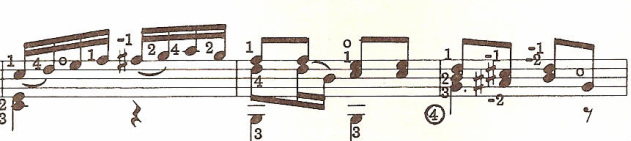
In Example 2, there is an opportunity to Relatively Position three fingers prior to the shift.  At the end of the first measure, the only finger still occupied is the second finger.  It is currently in Second Position (II).  The shift will take the left hand down to First Position (I) one fret away.  Therefore, the first finger prepares over the F# on the 1st string, the fourth finger prepares over the D# on the 2nd string, and the third finger prepares over the G# on the 6th string.  The shift takes care of everything else.

Example 2
Picture
Obviously, any fingers involved in Relative Positioning will need to be prepared ahead of the shift and the exact moment of preparation will vary from one passage to another.  Usually it is a good idea to prepare the fingers when the left hand is not busy depressing strings or clearing off of them.

Copyright © 2011 by Thomas Coffey     All Rights Reserved     Internatonal Copyright Secured