"Artificial" Harmonics
You may wish to review Harmonics and/or Tuning With Harmonics before reading any further.
"Artificial" Harmonics is a misnomer. There is no such thing as an "artificial" harmonic. Perhaps a better term would be "Right Hand Harmonics" or "Right Hand Octave Harmonics".
In any case, this specific type of harmonic is produced by the right hand, with the pad of "i" touching the node and either "p" or "a" playing the string.
"Artificial" Harmonics is a misnomer. There is no such thing as an "artificial" harmonic. Perhaps a better term would be "Right Hand Harmonics" or "Right Hand Octave Harmonics".
In any case, this specific type of harmonic is produced by the right hand, with the pad of "i" touching the node and either "p" or "a" playing the string.
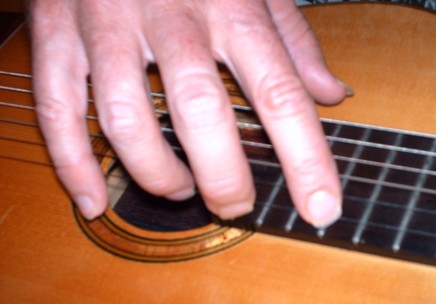
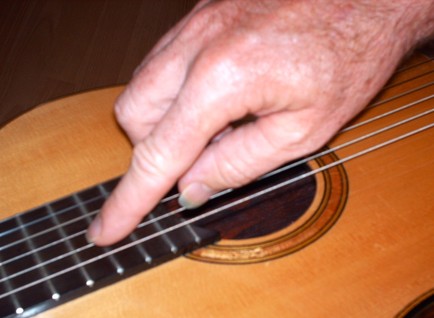
The "Artificial" part comes in when the left hand becomes involved. As you depress one of the strings with a left hand finger, the halfway point of the vibrating length of the string
changes. This node is always 12 frets higher than the fretted note.
For example, if you depress the 1st string in the third fret, the halfway point moves to over the fifteenth fret. If you touch this node with the pad of "i" and play the string with "a", you will sound a harmonic an octave higher than the fretted G.
Because any fretted note (or open string for that matter) can be played as an artificial harmonic, it is possible to play melodies entirely in harmonics. A good way to practice this is with a scale which is familiar enough that you don't need to look at the left hand (you will need your eyes to view the fretboard twelve frets above the melody.
As a rule, "Artificial" Harmonics on the first three strings are played with "a" and those on the lower strings are played with "p".
For example, if you depress the 1st string in the third fret, the halfway point moves to over the fifteenth fret. If you touch this node with the pad of "i" and play the string with "a", you will sound a harmonic an octave higher than the fretted G.
Because any fretted note (or open string for that matter) can be played as an artificial harmonic, it is possible to play melodies entirely in harmonics. A good way to practice this is with a scale which is familiar enough that you don't need to look at the left hand (you will need your eyes to view the fretboard twelve frets above the melody.
As a rule, "Artificial" Harmonics on the first three strings are played with "a" and those on the lower strings are played with "p".
Copyright © 2011 by Thomas Coffey All Rights Reserved Internatonal Copyright Secured